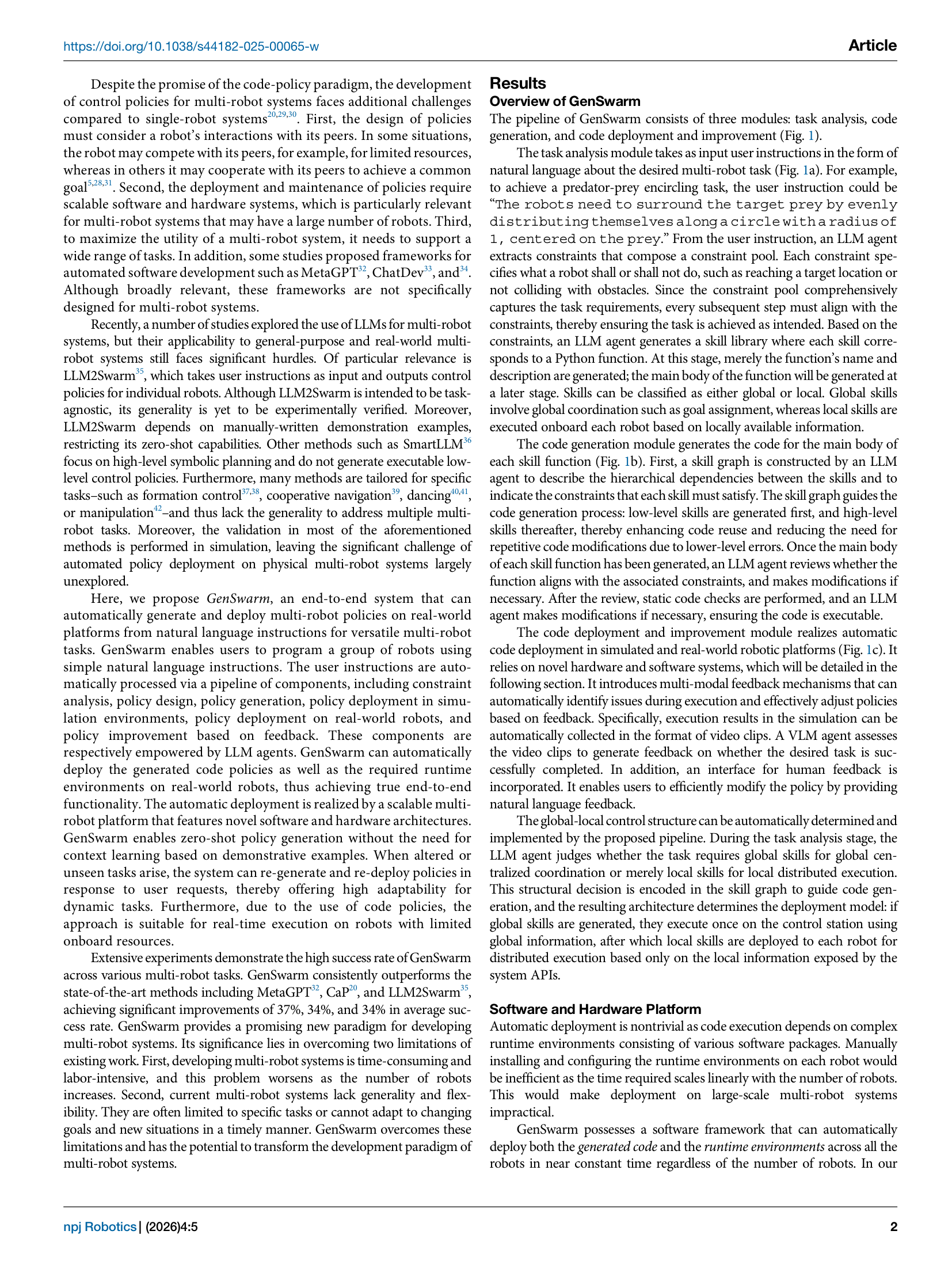
"Despite the promise of the code-policy paradigm, the development of control policies for multi-robot systems faces additional challenges compared to single-robot systems. First, the design of policies must consider a robot's interactions with its peers. In some situations, the robot may compete with its peers, for example, for limited resources, whereas in others it may cooperate with its peers to achieve a common goal. Second, the deployment and maintenance of policies require scalable software and hardware systems, which is particularly relevant for multi-robot systems that may have a large number of robots. Third, to maximize the utility of a multi-robot system, it needs to support a wide range of tasks. In addition, some studies proposed frameworks for automated software development such as MetaGPT, ChatDev. Although broadly relevant, these frameworks are not specifically designed for multi-robot systems. Recently, a number of studies explored the use of LLMs for multi-robot systems, but their applicability to general-purpose and real-world multi-robot systems still faces significant hurdles. Of particular relevance is LLM2Swarm, which takes user instructions as input and outputs control policies for individual robots. Although LLM2Swarm is intended to be task-agnostic, its generality is yet to be experimentally verified. Moreover, LLM2Swarm depends on manually-written demonstration examples, restricting its zero-shot capabilities. Other methods such as SmartLLM focus on high-level symbolic planning and do not generate executable low-level control policies. Furthermore, many methods are tailored for specific tasks–such as formation control, cooperative navigation, dancing, or manipulation–and thus lack the generality to address multiple multi-robot tasks. Moreover, the validation in most of the aforementioned methods is performed in simulation, leaving the significant challenge of automated policy deployment on physical multi-robot systems largely unexplored."
这是引言中信息密度最高、批评最为集中的一段,逻辑上分为两大层次:
前半部分——多机器人专属挑战:在代码策略范式的前提下,进一步指出三大额外挑战:① 需处理机器人间竞争与合作关系;② 部署与维护需要可扩展的软硬件系统;③ 需支持多样化任务。同时排除 MetaGPT、ChatDev 等看似相关但并非专为多机器人设计的方案。
后半部分——现有 LLM 方法逐一点评:
· LLM2Swarm:任务无关性缺乏实验验证,且依赖人工示例,零样本能力受限;
· SmartLLM:仅做高层符号规划,不生成可执行的底层控制代码;
· 其他方法:大多针对特定任务(编队、导航、舞蹈、操作),缺乏通用性;
· 普遍问题:验证停留在仿真层面,真实机器人平台上的自动化部署尚属空白。
逻辑意义:本段完成了漏斗式收窄的最关键一环。前半部分将问题从"通用 LLM 局限"进一步收窄到"多机器人专属挑战",排除不适用的通用方案;后半部分对已有方法逐一批评,每一条批评都精准对应 GenSwarm 的某项设计决策。这是研究空白最直接的论证——它定义了"还缺什么",从而为 ¶6 的方案呈现创造了完美的出场时机。